Convoy Driving Etiquette and Hand Signals
Convoy driving etiquette comes down to five habits. Keep at least three seconds of following distance. Signal every move early. Hold a fixed running order with a lead car and a sweep car. Never block other traffic to keep the group together, and agree in advance on what happens when someone gets separated. Hand signals cover the rest when radios cut out.
The short version
- Three seconds of space. The California Driver’s Handbook sets three seconds as the minimum safe following distance — convoys need that gap more, not less.
- Three hand signals. Left arm straight out, bent up, and bent down cover turn left, turn right, and slow or stop.
- Fixed running order. Lead car navigates, sweep car runs last, everyone else keeps their slot.
- Never block traffic. A convoy has no legal right to stay together through a light or a merge.
- Plan the separation. Decide the next regroup point before you leave, so a lost car has somewhere to go.
Vamio exists because our own crew kept getting split up on night drives, and every fix we tried — group texts, phone calls, one person navigating for everybody — made the driving worse instead of better. The rules below are the ones that actually held up.
What is convoy driving etiquette?
Convoy driving etiquette is the set of unwritten rules that let several vehicles travel as one group without endangering each other or the traffic around them. It covers spacing, signaling, running order, how to handle stops, and what to do when the group breaks apart. Most of it exists for one reason: a convoy behaves like a single long vehicle in the eyes of other drivers, but it is made of drivers who can’t see or hear each other. Good etiquette closes that gap. Bad etiquette produces the convoy stereotype — a knot of cars tailgating each other, running amber lights, and refusing to let anyone merge.
What hand signals do convoy drivers use?
Convoys use the three standard hand-and-arm signals from every state driver’s handbook, plus a small set of agreed extras. The California DMV documents the standard three (California Driver’s Handbook):
- Left arm extended straight out — turning left.
- Left arm bent upward at the elbow — turning right.
- Left arm angled down, palm back — slowing or stopping.
The handbook lists these as the fallback when signal lights fail or bright sun makes them hard to read. That is exactly the convoy case. The car three back often can’t see your indicators at all.
Beyond those three, convoys usually agree on a few extras before rolling out. Hazard lights mean an obstacle ahead. A short headlight flash from the sweep car means the group is strung out too far. A raised fist or open palm out the window means pull over at the next opportunity. None of these are standardized, so settle them at the driver’s meeting rather than assuming everyone shares your group’s vocabulary.
How much space should you leave between convoy vehicles?
Leave at least three seconds of following distance, the same minimum the California Driver’s Handbook gives every driver (Navigating the Roads). Convoy drivers routinely cut that to one second or less, believing a tight pack keeps the group together. It does the opposite. A tight pack means one brake tap propagates down the line as a panic stop, and it leaves no room for other traffic to merge, which is what turns a convoy into a road hazard.
The right mental model is a loose chain, not a bumper-to-bumper train. Three seconds is enough to stop safely and still keep the car ahead in sight on most roads. If someone slots into your gap, drop back and rebuild it rather than closing up. You lose a few car lengths and gain the ability to actually react.
Assign a lead car, a sweep car, and a running order
Three roles make a convoy work. The lead car navigates, sets the pace, and never accelerates to shake the back of the group. The sweep car drives last, watches for stragglers, and is the only car that reports the group is stretched too thin. Everyone else holds a fixed slot in the running order for the whole trip.
Fixed order matters more than people expect. When each driver only has to track the specific car ahead and the specific car behind, the coordination problem shrinks to something a driver can handle at speed. Put slower or less confident drivers near the front, where the pace is set, rather than at the back where they have to chase. Keep sub-groups small — four or five cars is easy to hold, twelve is not. For a bigger event, split into several convoys with paired leads instead of one enormous line.
How should a convoy handle merges, exits, and lane changes?
A convoy has no special right to stay together, so the rule is simple: never block other traffic to preserve the group. Don’t straddle two lanes to hold a gap, don’t run an amber light because the car ahead did, and don’t refuse to let a non-convoy vehicle merge into your line.
Signal early and let the group follow the signal, not the car. The California handbook asks for a signal at least 100 feet before a turn, and five seconds — roughly 400 feet — before exiting a highway. For a convoy, start earlier than that. When the lead car signals a lane change 400 feet out, every driver behind has time to find a gap and move over individually instead of all lunging at once. Move one or two cars at a time, back to front, and rebuild the running order afterwards. If half the group misses an exit, the group that made it pulls over safely and waits; nobody reverses on a ramp.
Fuel stops, rest stops, and the no-wait-at-the-pump rule
Agree on stops before departure, not over the radio at speed. Name the actual gas stations or rest areas and space them roughly every 45 to 60 minutes, so a car that falls behind always knows where the group will be. At the pump, fill and then move the vehicle to a parking spot before going inside — a convoy that blocks every pump while its drivers buy coffee is the reason some stations turn groups away.
Set a departure signal too. Something as simple as “everyone back in the cars, sweep confirms, lead pulls out” prevents the ten-minute drift where nobody knows if the group is still waiting on someone. Top up fuel together even when only one car needs it, since a convoy travels at the range of its smallest tank.
What should a convoy do when a car gets separated?
The separated car continues to the next agreed regroup point, and the rest of the group waits there. That’s the whole plan, and it works because it needs no communication at all. What ruins it is improvising: the lost driver calls the lead, the lead answers while driving, and now two cars are distracted instead of one.
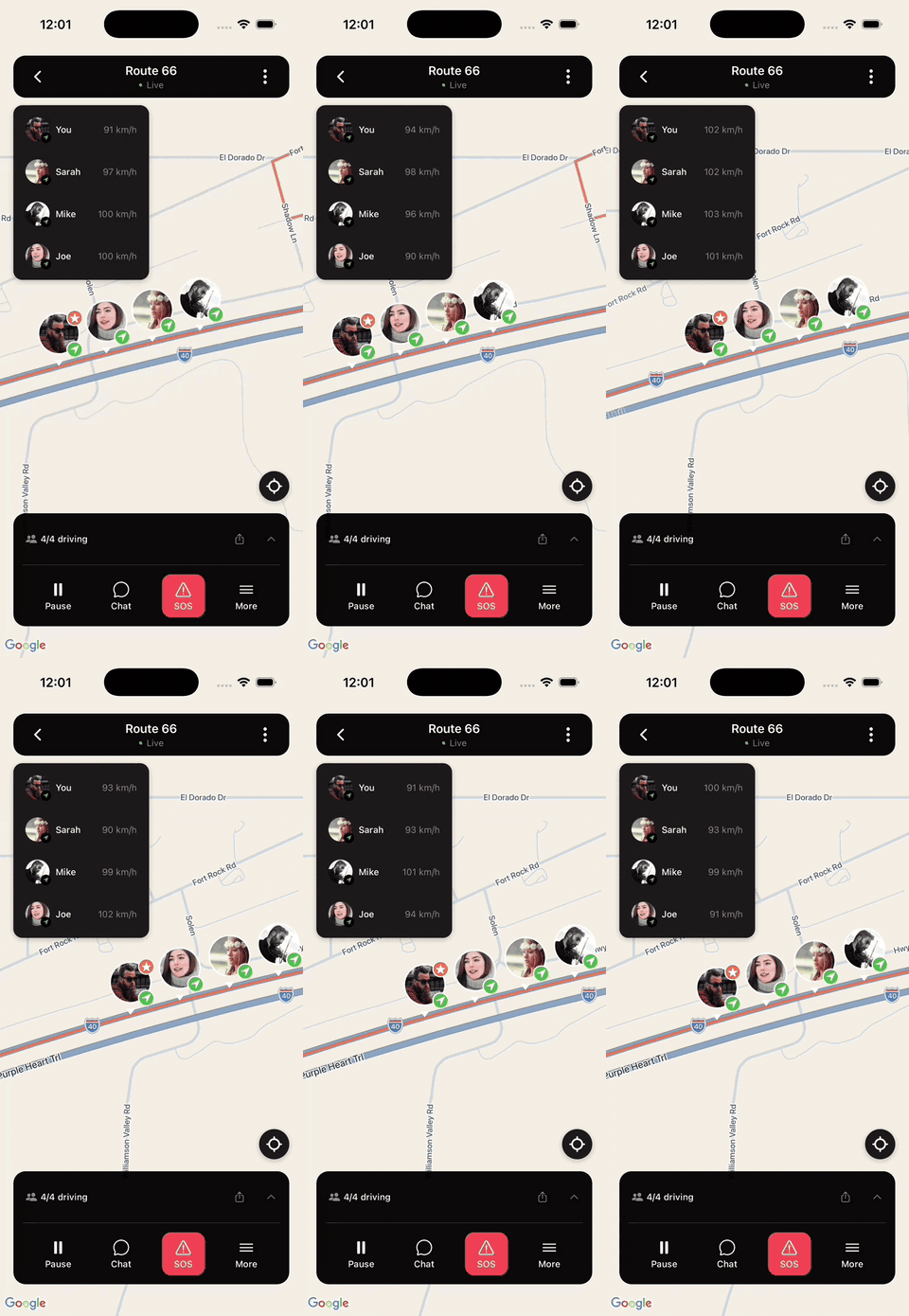
Keep everything glanceable while moving. NHTSA notes that the five seconds a text takes at 55 mph is like driving the length of a football field with your eyes closed (NHTSA). A shared live map answers “where is everyone” without any reading. Apps like Vamio put the whole convoy on one map and use about 5–10 MB of data per hour-long drive. A one-tap SOS sends your exact location to the group if you break down (how Vamio handles safety). Location is shared only while the drive is active and stops when it ends. For the trade-offs between maps, radios, and chat, see walkie-talkies vs group chat vs apps.
A convoy driving etiquette checklist
Run the driver’s meeting before you pull out:
- Confirm the route and the regroup points, spaced every 45–60 minutes.
- Assign lead, sweep, and the running order — write it down.
- Agree the hand signals, including any extras beyond the standard three.
- Set the spacing rule — three seconds minimum, rebuild the gap if someone merges in.
- State the traffic rule out loud: nobody blocks other drivers to keep the group together.
- Set the separation plan — continue to the next regroup point, no phone calls.
- Mount and charge every phone, and get everyone on the same live map.
- Agree the emergency signal and make sure every driver knows how to send it.
For the formation habits behind all of this, see how to keep a group together on a road trip.
Plan your next convoy with Vamio
Vamio is a free group-driving app for convoys and road trips, on iOS 16+ and Android 10+. The free plan puts up to 20 people on one live map at $0, and invites join by link with no sign-up. In-drive chat and one-tap SOS keep the group coordinated without anyone reading a thread at speed. Download Vamio and set your convoy up before the driver’s meeting, not during it.
