How to Organize a Car Meet or Cruise: 10 Steps
Organizing a car meet takes four things: a location whose owner has given you written permission, a posted set of rules, a headcount you can actually manage, and a plan for how cars leave at the end. Everything else is decoration. Start with the property owner, because that one conversation decides whether the meet happens twice.
The short version
- Permission in writing. A verbal yes from a shift manager is not permission. Get the property owner or their agent on email.
- Cap the first one near 20 cars. Small is survivable. You can grow the second meet once you know how the lot behaves.
- Rules posted before arrival, not shouted after something goes wrong: no revving, no burnouts, no blocking the entrance.
- Cruising is legal in California since AB 436 took effect on January 1, 2024 — but speed contests and exhibitions of speed are still a crime under Vehicle Code 23109.
- Plan the exit. Most meets die from how cars leave, not from what happened while they were parked.
We built Vamio because our own crew kept losing each other on night drives. The thing we noticed while organizing those runs is that the driving is the easy part. A meet is won or lost in the twenty minutes in the parking lot before rollout — who knows the route, who knows the rules, and who knows what happens if they fall behind.
What do you need to organize a car meet?
You need five things, in this order: a confirmed location, a date and a window, a rules list, a way to reach everyone on the day, and someone who is visibly in charge. That last one matters more than the flyer. A meet with no obvious organizer becomes a meet where nobody has standing to tell a driver to stop revving.
Write the rules down before you invite anyone. Three lines is enough for the first draft — no burnouts or exhibition driving, no blocking traffic or the entrance, leave the lot cleaner than you found it. Put those in the invite, on the flyer, and say them out loud when people arrive. Rules that show up only after a problem read as blame; rules that show up first read as the deal everyone agreed to.
Where can you legally hold a car meet?
On private property, with the owner’s written permission. That is the short answer and there is not really a second one. Retail lots, business parks after hours, fairgrounds, and racetrack paddocks are the usual candidates, and all four have an owner who can say yes.
Ask the property owner or their leasing agent, not the closing-shift manager, and ask by email so you have the yes in writing. Tell them the date, the two-hour window, the expected car count, and who is responsible if something goes wrong. Offer something concrete: bring the meet during dead hours, promise a cleanup, hand over your phone number. Many owners have been burned by an unannounced crowd and will say no to a stranger while saying yes to someone who shows up with a plan.
Public streets are the trap. A group parked along a public road is a parking issue at best and an obstruction at worst, and it hands local police an easy reason to disperse the whole thing.
Is cruising legal?
In California, yes — cruising itself is legal statewide. Assembly Bill 436 took effect on January 1, 2024 and removed the authority local governments had used to pass anti-cruising ordinances (SEMA). Lowrider clubs spent decades pushing for that change, and it undid ordinances widely criticized as discriminatory.
What did not change is everything the state already prohibited. California Vehicle Code 23109 still makes it a crime to engage in a speed contest or an exhibition of speed on a highway or in an offstreet parking facility, or to aid and abet one (Vehicle Code 23109). A first conviction carries a $355 to $1,000 fine, up to 90 days in county jail, 40 hours of community service, and a 90-day to 6-month license suspension. The same section defines a sideshow as two or more people blocking traffic to perform stunts for spectators.
So the line runs between rolling and performing. Driving slowly in a group is cruising. One burnout in the lot converts your meet into the thing the statute was written for, and the offstreet parking facility wording means a private lot is no shelter. Outside California, cruising rules are set locally, so check your city’s municipal code before you publish a route.
How many cars should your first meet have?
Cap the first one near 20. A group that size fits in a corner of most lots, parks without a marshal, and can be talked to in one go without a PA system. It is also small enough that you personally know most of the drivers, which is the real crowd control.
The number matters because meets scale badly. Twenty cars is a gathering. Sixty is an event that needs parking direction, a second organizer, and a conversation with the property owner about liability. If you are cruising afterwards, keep the rolling group smaller still and split into sub-groups of four or five cars with a lead and a sweep in each, the same formation described in convoy driving etiquette. A single line of 20 cars cannot hold together through two traffic lights.
How do you keep everyone coordinated on a cruise?
Put every car on one shared live map and stop trying to coordinate by phone. A cruise breaks apart at lights, merges, and the first gas stop, and each break sends someone to their phone for directions while moving.
Set the route and the regroup points before rollout, spaced roughly every 45 to 60 minutes on a longer run, or at each planned stop on a short one. Hold at least three seconds of following distance, the minimum the California Driver’s Handbook gives every driver, and signal about 100 feet before a turn so the cars behind can move one at a time instead of lunging together (California Driver’s Handbook). Never block other traffic to keep the group intact.
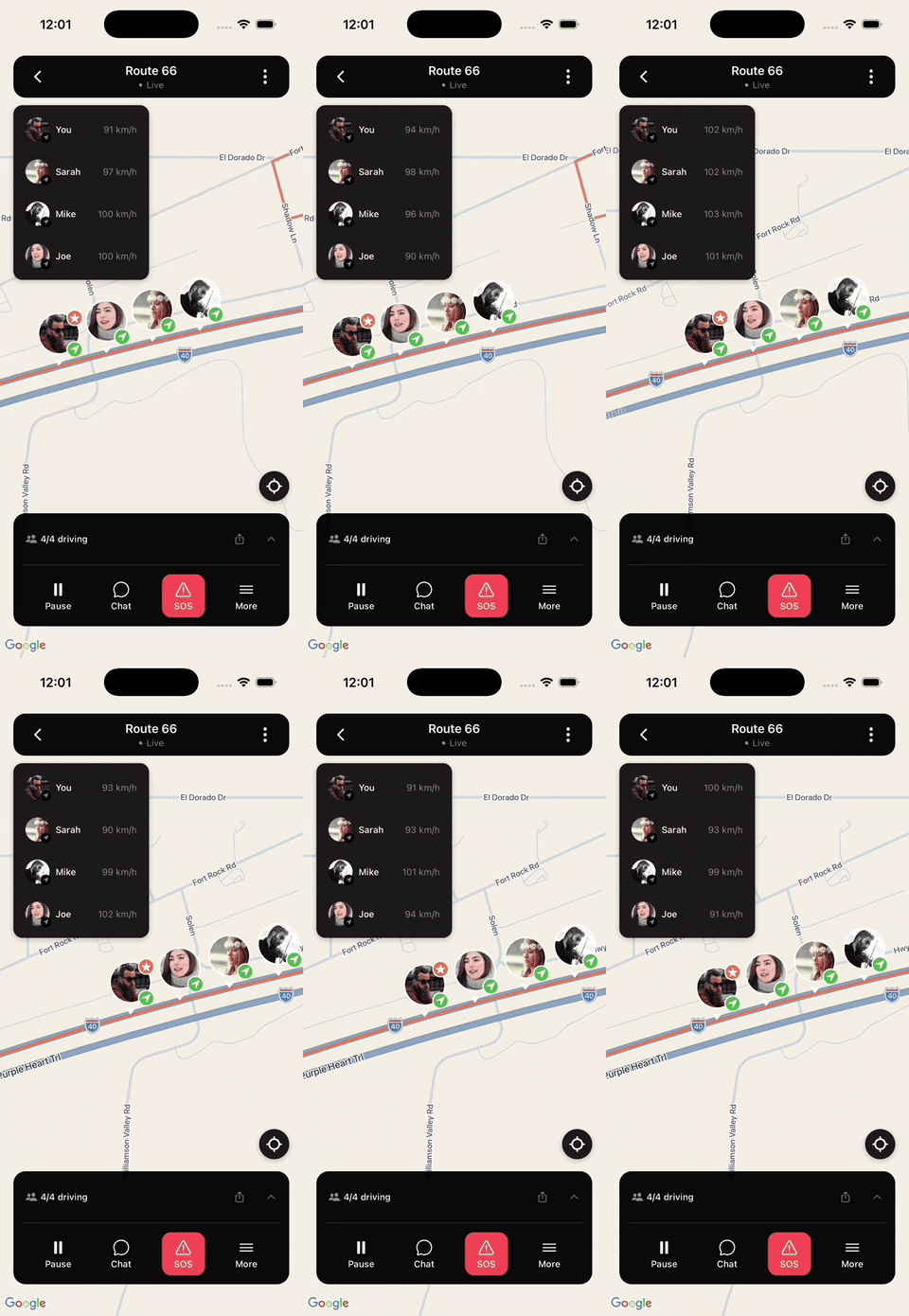
Apps like Vamio put the whole group on one map for the length of the drive and use about 5–10 MB of data per hour. Location is shared only while the drive is active and stops when it ends, with no background tracking (how Vamio handles location). A one-tap SOS sends an exact location if a car breaks down. For the wider comparison of maps, radios, and group chat, see walkie-talkies vs group chat vs apps.
Plan the exit before you plan the arrival
Meets get shut down on the way out. A lot empties in a burst, and a burst of cars leaving one driveway at once produces the noise, the queue across the road, and the one driver who decides the exit is a good place for a rev.
Stage the departure instead. Announce a hard end time, then release the lot in small waves of four or five cars a couple of minutes apart, with the loudest going last and going quietly. Two minutes between waves is enough to stop a queue forming across the road. Ask people to leave in the direction away from housing. Do a litter sweep before anyone drives off, and send the property owner a short thank-you the next day — that message is what gets you the lot again in a month.
A 10-step car meet checklist
- Pick the location and identify who actually owns or leases it.
- Get written permission by email, with the date, the window, and your phone number.
- Set a two-hour window during the property’s dead hours.
- Write three rules: no exhibition driving, no blocking traffic, leave it clean.
- Cap the headcount near 20 cars for the first meet.
- Publish the rules with the invite, not on the day.
- Name an organizer and a backup so someone has standing to intervene.
- Plan the cruise route with regroup points, and split into groups of four or five cars.
- Get everyone on one live map and confirm each driver’s phone is mounted and charged.
- Stage the exit in waves, sweep for litter, and thank the owner afterwards.
If your meet ends with a longer drive, the formation habits in how to keep a group together on a road trip apply from the moment you leave the lot.
Run your next meet with Vamio
Vamio is a free group-driving app built for cruises, rallies, and road trips, on iOS 16+ and Android 10+. The free plan puts up to 20 people on one live map at $0, and drivers join by invite link with no sign-up, which suits a meet where half the group are strangers. In-drive chat and one-tap SOS keep the cruise together without anyone reading a thread at speed. Download Vamio before the meet, and spend the parking-lot twenty minutes on the route instead of on the roll call.
